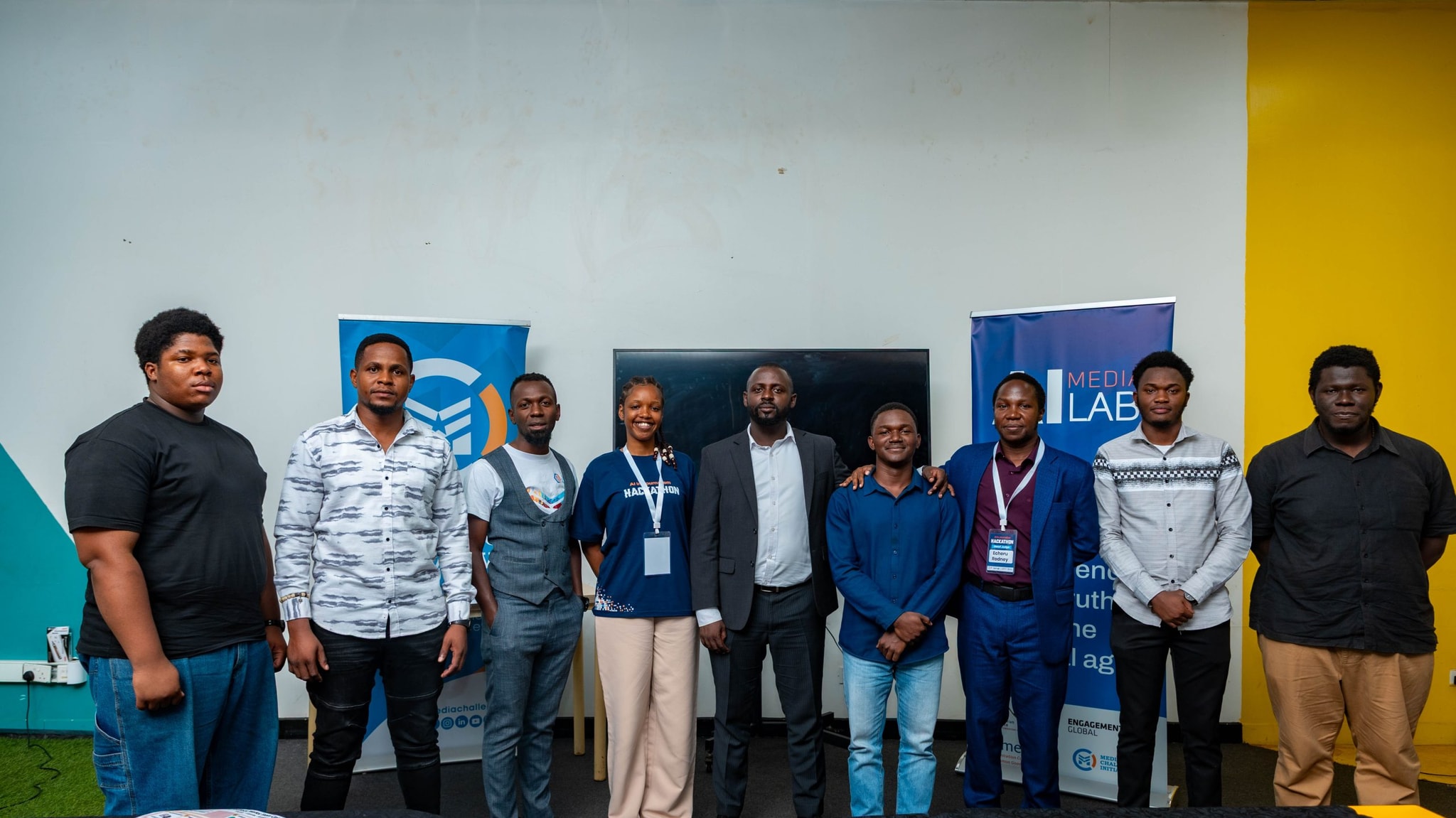
Seven university teams, 48 hours and one stubborn problem: how do you stop disinformation from spreading faster than the truth? That was the challenge put to young journalists and technologists in Uganda at the 2026 Media Challenge Initiative (MCI) AI Hackathon. When the weekend ended, Uganda Christian University (UCU) had taken first place with Sherlock, a WhatsApp chatbot that verifies disinformation.
Media Challenge Initiative (MCI) is a Ugandan youth-led organisation that works to strengthen journalism by developing the skills of young journalists and supporting the newsrooms they will work in. Its AI Media Lab Hackathon is part of that mission, bringing students together to build practical, AI-powered tools for the challenges newsrooms face today. It ran alongside the 2026 Africa Newsroom Contest (ANC), which carried the theme “Harnessing AI to Reimagine Our Communities Through Responsible Journalism.”
The building took place at the MCI AI Media Lab, the initiative’s space for helping young journalists and newsrooms work directly with artificial intelligence. The Lab exists to close a gap its team sees clearly. As AI reshapes how news is gathered, verified and distributed, newsrooms need people who can do more than talk about it. They need people who can build with it.
“As artificial intelligence (AI) reshapes how news is gathered, verified and distributed, newsrooms need people who can do more than talk about AI. They need people who can build with it, hence we are working with young journalists to build these AI-powered prototypes for newsrooms,” said Emmanuel Bahindi, the Technical Lead for the MCI AI Media Lab.
Seven universities took part in the Hackathon: Makerere University, Uganda Christian University, Nkumba University, Cavendish University in Uganda, St. Lawrence University, Victoria University and Kampala International University (KIU). Each team had three students, two from journalism and communication studies and one from Information Technology. The idea was to put the people who understand the story next to the person who knows how to build the tool. Journalists brought the questions a newsroom actually faces, and the IT students turned them into working software.
The brief the students had was deliberately concrete. Rather than a classroom exercise or a pitch built on promises, each team had 48 hours to build a working AI prototype for detecting disinformation, aimed at a real newsroom challenge. The teams traded lecture notes for laptops, turning what they had learnt in class into something a newsroom could actually run.
On Thursday 29th October, the teams presented their prototypes to a panel of judges who work with newsrooms and technology every day. UCU’s entry stood out. Their prototype Sherlock lets users check claims through WhatsApp, which makes verification easy to reach for the people most exposed to false information.
The choice of platform was part of the point. “Our prototype (Sherlock) addressed a challenge of news verification, and disinformation tracking through using WhatsApp, a popular social media platform,” said Ivan Nyokabi, a journalism student at Uganda Christian University. Through placing a verification tool inside an app that millions of people already use every day, the team made fact-checking something a reader can do in a few taps, rather than a specialist task done behind a newsroom door.
The hackathon is part of MCI’s wider work to strengthen journalism in the age of AI. It is linked to the project Integrating AI Competences for Fighting Disinformation into Journalism Education. As disinformation grows more sophisticated, MCI’s approach is to put capable tools in the hands of the next generation of journalists and to teach them to use those tools responsibly. The AI Media Lab is where that approach becomes practical: students, technologists and newsroom needs come together, and ideas are built and tested rather than just discussed.
The UCU team will receive their accolade at the Media Challenge Awards ceremony on 13th December, 2026.
The hackathon was organised by the Media Challenge Initiative (MCI) in partnership with Deutsche Gesellschaft für Internationale Zusammenarbeit (GIZ), Engagement Global and the Catholic Media Council. (CAMECO)
