
There's a quiet gap sitting at the center of journalism education in East Africa right now, and most institutions haven't named it yet.
Universities across the region, Makerere University, the University of Nairobi, Daystar University, and Victoria University among others have started building digital journalism courses. Good ones. But ask any of them where the lecture is that explicitly teaches AI and disinformation together, and you'll come up empty. Students are being trained for a media landscape that no longer exists, while the tools reshaping their future newsrooms move ahead without them.
That gap isn't abstract. It has consequences. Disinformation already spreads faster than fact-checking can catch it. Add AI-generated content into that mix, without the journalists on the front lines knowing how to recognize it, and you get an information ecosystem that erodes trust faster than institutions can rebuild it.
At Media Challenge Initiative, we didn't think this was a gap to write about. We thought it was a gap to close.
Here's where we made a deliberate choice: rather than teaching students directly and hoping it scales, we started with the educators.
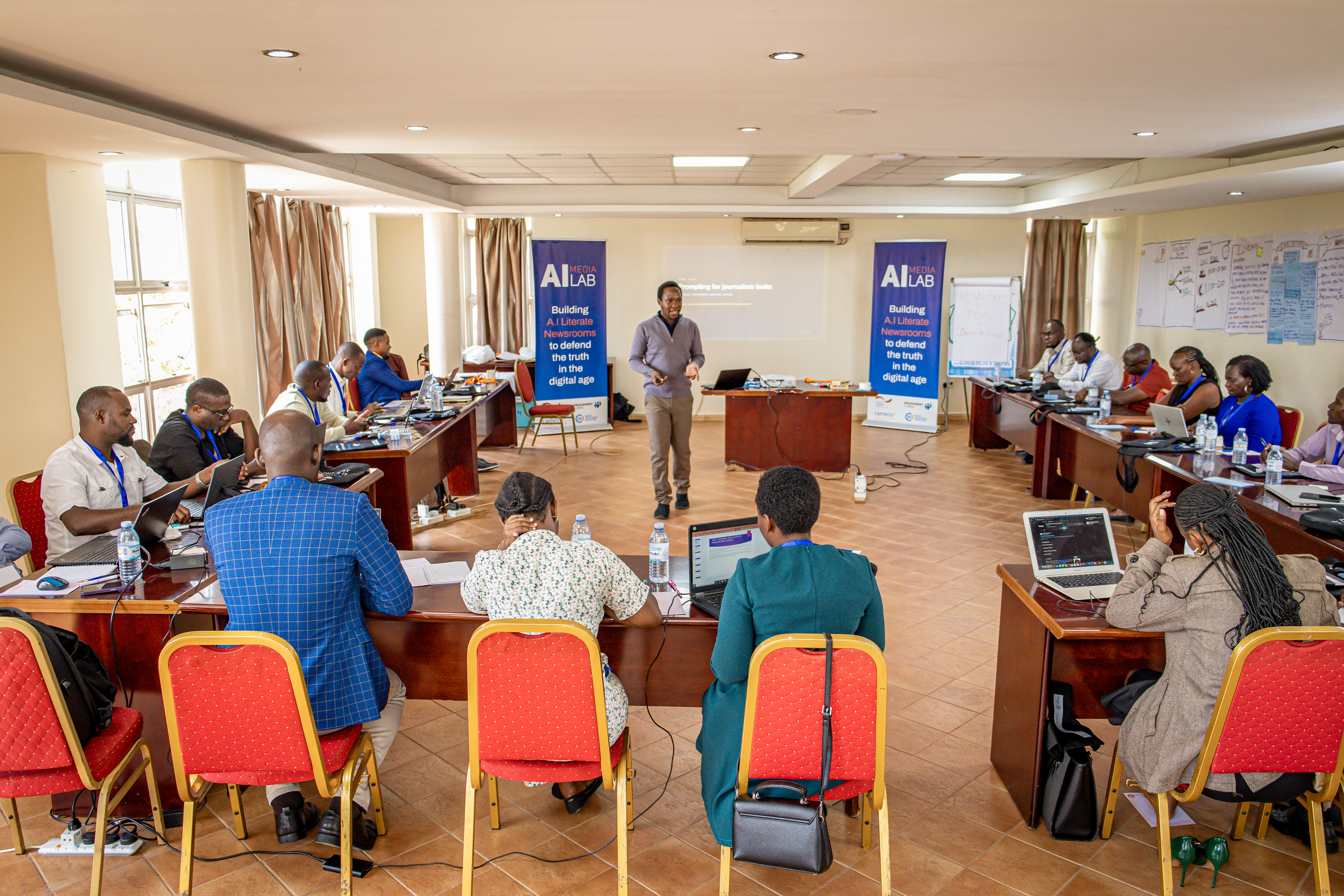
From 26th July to 31st July, 2026, 22 journalism educators from across East Africa, came together in Kampala for a residential Training of Trainers (ToT). Not a workshop where they learnt about AI. A workshop where they learned to teach it, confidently, practically, and ethically, using real tools in fact-checking and digital journalism workflows.
The logic is simple: one well-equipped educator can reach hundreds of students. Twenty-two of them, across 15 universities, are now piloting the curriculum with their own classes between August and October, a reach of 400 students this cycle alone.
The trained educators will run endline evaluations with their students, nominate top performers for an AI Journalism Hackathon in November where student teams will get a chance to build actual AI-based disinformation detection prototypes and carry the case for integrating AI journalism modules back into their own university curricula long-term.
We're not sharing this because we think MCI has it all figured out. We're sharing it because the gap we identified in East African journalism education is real, and it isn't unique to Uganda or Kenya. Other institutions, across the continent and beyond, are facing the same lag between what AI can do and what journalism training actually teaches.
If there's one thing we'd want another journalism school, media organization, or funder to take from this: don't wait for the curriculum to catch up on its own. Build the room, write the modules, train the trainers, and let it multiply.
Because the next generation of journalists isn't just going to report on an AI-shaped world. They're going to need the tools to hold it accountable.
This AI Media Lab project is in partnership with the Catholic Media Council (CAMECO) and the Erich Brost Institute for International Journalism (EBI).